Solar Rooftop Survey-to-Proposal Copilot for Commercial EPC Teams
How commercial solar EPC teams can turn rooftop survey photos, electricity bills, site constraints, and ROI targets into faster first-draft proposals without waiting on senior engineers for every lead.
Proposal speed is a commercial bottleneck in solar EPC
In commercial solar projects, the delay often starts before engineering design is fully underway. A prospect asks for a proposal, the sales team collects site photos and electricity bills, someone tries to estimate roof potential, and then the opportunity waits in a queue for a senior engineer to turn rough data into a credible first draft.
That queue becomes expensive when deal volume grows. Leads go cold. Follow-up becomes slower than competitors. Junior sales people depend too heavily on a small number of technical reviewers. The business does not lose because it lacks interest in solar. It loses because the first proposal takes too long to become review-ready.
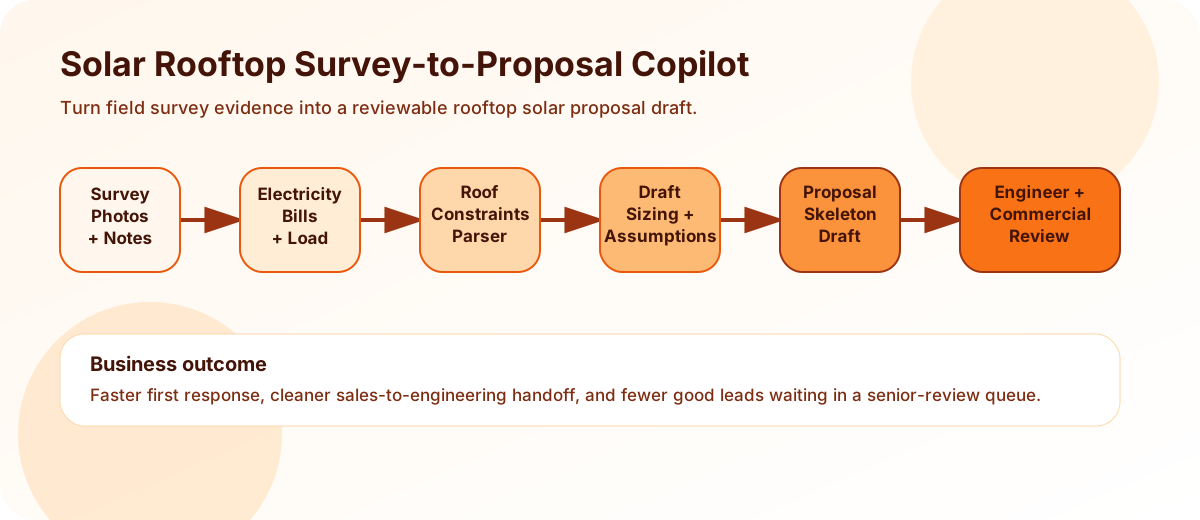
A Solar Rooftop Survey-to-Proposal Copilot is a focused workflow for this exact gap: take survey evidence, utility usage, roof constraints, and commercial targets, then generate a structured draft that helps the engineering team respond faster without pretending that AI should approve the final design by itself.
The survey data already exists. It is just scattered.
Most EPC teams already have the raw material for a first draft proposal. They have rooftop photos, drone images in some cases, electricity bills, notes from field visits, rough roof dimensions, panel preferences, client targets, and commercial context about payback expectations or budget sensitivity.
The problem is that the information usually arrives in fragments. Some of it sits in WhatsApp. Some is inside email threads. Some lives in a salesperson's notes. Some sits in Google Drive with inconsistent file names. By the time an engineer reviews the opportunity, they are not starting from clean input. They are reconstructing context.
The stronger workflow is not to ask sales teams to become design engineers. The stronger workflow is to give them a disciplined intake path, then let a copilot organize the evidence, identify what is missing, and create a proposal draft that is much closer to engineer-ready.
What the copilot should read before it drafts anything
A useful first version should stay practical. It should read electricity bills to understand historical consumption, capture roof type and usable area from survey notes, record visible constraints such as shading, parapet height, equipment clutter, or panel orientation issues, and store the commercial target behind the deal.
That target matters. Some clients care about the shortest payback period. Others care about a capex ceiling, an ESG narrative, or a specific percentage offset against daytime load. A proposal workflow that ignores the business objective will generate drafts that look neat but miss the real sales context.
Once those inputs are structured, the copilot can draft a first system recommendation, highlight missing assumptions, list clarification questions, and prepare the commercial narrative that sales and engineering can refine together.
Collect the real survey evidence.
Photos, bills, site notes, roof dimensions, shading observations, and client targets move into one structured opportunity record.
Turn raw input into a proposal starter.
The system drafts sizing assumptions, flags missing data, proposes clarifying questions, and prepares the first commercial outline.
Keep design authority with humans.
Senior engineers review layout assumptions, electrical constraints, and commercial risk before anything is sent to the client.
The first draft should include engineering context, not only sales prose
Many proposal tools fail because they generate text faster than they generate useful structure. What the engineering team needs is not a prettier paragraph. They need a draft that already contains the bones of the opportunity: estimated capacity range, key assumptions, visible site constraints, target ROI logic, exclusions, and open technical questions.
That means the copilot should produce more than an introductory letter. It should create a proposal scaffold that is actually reviewable. If roof area is uncertain, that must be explicit. If daytime load profile is unknown, that must be explicit. If the site appears to have multiple roof elevations or partial shading, that should already be noted before the engineer touches the file.
This is the difference between AI as decoration and AI as workflow acceleration. The goal is to reduce reconstruction work for the technical team, not just generate polished language for the sales deck.
type SurveyProposalDraft = {
  opportunityId: string
  clientName: string
  monthlyKwhHistory: number[]
  estimatedRoofAreaM2?: number
  visibleConstraints: string[]
  targetObjective: 'roi' | 'capex_limit' | 'energy_offset' | 'esg'
  proposedCapacityRangeKwp: { min: number; max: number }
  clarificationQuestions: string[]
  engineeringReviewStatus: 'draft' | 'needs_review' | 'approved_for_revision'
}
Human review stays mandatory for layout, structure, and commercial risk
A solar EPC proposal cannot be treated like an auto-generated brochure. Roof structure, access limitations, electrical interconnection, panel density, inverter strategy, load profile, and client contract assumptions all carry risk. The copilot can accelerate preparation, but it should not pretend to sign off on design feasibility or final yield confidence.
That is why the workflow needs a hard review boundary. AI prepares the first pass. Engineers check structural and electrical plausibility. Commercial reviewers confirm pricing, exclusions, installation assumptions, and delivery scope. Nothing should move to the client as if it were production-ready until those approvals are complete.
In practice, this makes the product more useful, not less. Commercial teams gain speed, while engineering leadership keeps control over technical accuracy and proposal credibility.
Why this matters for commercial solar EPC teams
Commercial rooftop solar is becoming more competitive. Buyers often compare multiple EPCs at once, and the first serious response has an advantage. Not because speed alone closes the deal, but because speed shapes confidence. A faster, clearer first draft keeps the conversation moving while slower competitors are still assembling attachments.
There is also an internal leverage benefit. The company does not need every opportunity to begin with a senior engineer manually reconstructing survey context from scratch. A disciplined proposal copilot lets junior sales-engineering staff operate with better structure, while senior people focus on review, exception handling, and higher-risk opportunities.
For growing EPC teams, that can change proposal capacity without immediately expanding headcount. The workflow becomes sharper, the handoff cleaner, and the sales team spends less time chasing missing context.
What NovaFlow would build first
NovaFlow would start with a focused MVP around opportunity intake, document capture, survey evidence organization, draft sizing assumptions, clarification question generation, and proposal skeleton output. The system does not need to become a full PV design suite on day one to create value.
The first useful version should make one thing obvious: this lead is ready for engineering review, this one is still missing key inputs, and this proposal can be drafted now with a transparent assumption set. That alone removes a surprising amount of commercial friction.
After the workflow is trusted, the product can expand into template libraries, proposal analytics, revision tracking, approval states, CRM handoff, and eventually deeper integration with layout or yield tools where appropriate.
The outcome is faster proposals with cleaner handoff
A Solar Rooftop Survey-to-Proposal Copilot is not about replacing engineers. It is about reducing the dead time between field survey and serious proposal response. That delay is where many commercial solar teams quietly lose momentum.
When survey evidence, utility history, rooftop constraints, and business targets move into one structured drafting workflow, the proposal process becomes easier to scale. Sales gets faster first responses. Engineers get cleaner inputs. Management gets better visibility into how opportunities are progressing.
That is the real opportunity for NovaFlow: build a practical workflow layer around the early commercial bottleneck, then turn that layer into a durable proposal system for solar EPC teams that need speed without losing technical discipline.