Verifying Cluster Housing Progress from Daily Site Photos
How an agentic AI layer can turn daily construction photos into milestone evidence, payment support, and clearer project control for cluster housing projects.
Construction progress is often reported, but not verified
Small developers and cluster housing contractors usually receive many daily site photos. Workers, mandors, supervisors, and vendors send updates through WhatsApp groups throughout the day.
The photos are useful, but they are rarely structured. A manager still has to scroll, compare, remember the unit number, ask whether the same area was photographed yesterday, and decide whether the work is really ready for payment or only visually busy.
A Site Photo Progress Verifier changes that pattern. It uses an agentic AI layer to help turn field photos into milestone evidence.
The problem is not lack of photos
Most project teams already take photos. The problem is that photos do not automatically answer operational questions: which unit is this, what milestone does it prove, what work is missing, and can this support a payment claim?
Without structure, photo reporting becomes a weak form of progress control. The same wall can be photographed from different angles. A contractor may show activity without showing completion. A milestone may be claimed before prerequisite work is actually done.
This creates friction between developer, contractor, supervisor, finance, and vendor teams.
AI can classify the photo before a manager reviews it
The first useful layer is not magic automation. It is structured classification. The system can ask: which project is this, which block or unit, which work category, which milestone, and whether the image contains enough evidence to support the claim.
For example, a photo may be linked to Unit B-12, roofing stage, truss installed, but flagged because the image does not show enough connection detail. Another photo may show plastering progress but fail the milestone because floor protection or corner finishing is incomplete.
This helps managers review exceptions instead of manually inspecting every image from zero.
Capture site photos with project context.
Each image should be tied to unit, stage, sender, timestamp, and expected milestone.
Flag incomplete or weak evidence.
The AI layer can compare the image against checklist rules and surface items that need human review.
Turn approved progress into cleaner claim evidence.
Finance and project owners can review milestone evidence before approving termin or vendor payment.
Milestones need checklists, not just percentages
Progress percentages are often too vague. A unit can be called 60 percent complete by one person and 45 percent complete by another. That ambiguity creates conflict.
A stronger workflow breaks the project into milestone checklists: foundation, structure, walls, roof, electrical rough-in, plumbing, plastering, flooring, doors, painting, fixtures, finishing, and handover items.
Each milestone can define what evidence is required. The AI agent can then compare incoming photos against that evidence checklist and highlight gaps for the supervisor.
Payment claims become easier to defend
Termin payments are sensitive because they connect site reality to cashflow. If progress evidence is weak, owners hesitate. If review is slow, contractors complain. If approval is too loose, project margin suffers.
A verifier does not need to automatically approve payments. It should prepare the evidence package: relevant photos, milestone status, missing checks, previous comparison, supervisor notes, and recommendation for human review.
This makes payment discussions more factual and less dependent on chat history.
The system can detect missing continuity
One common issue in site reporting is selective evidence. A team may send a strong photo from one angle, but not show the area that matters. Or a photo may show the work today but not prove that the previous prerequisite was completed correctly.
The AI layer can help by checking continuity: compare recent photos for the same unit, detect whether required views are missing, and ask for a repeat photo with clearer angle or distance.
This is useful because construction control is not only about what appears in one photo. It is about whether the evidence sequence makes sense.
WhatsApp can be the input, but not the archive
Field teams may continue sending photos through WhatsApp because it is fast and familiar. But the project should not rely on WhatsApp as the final archive.
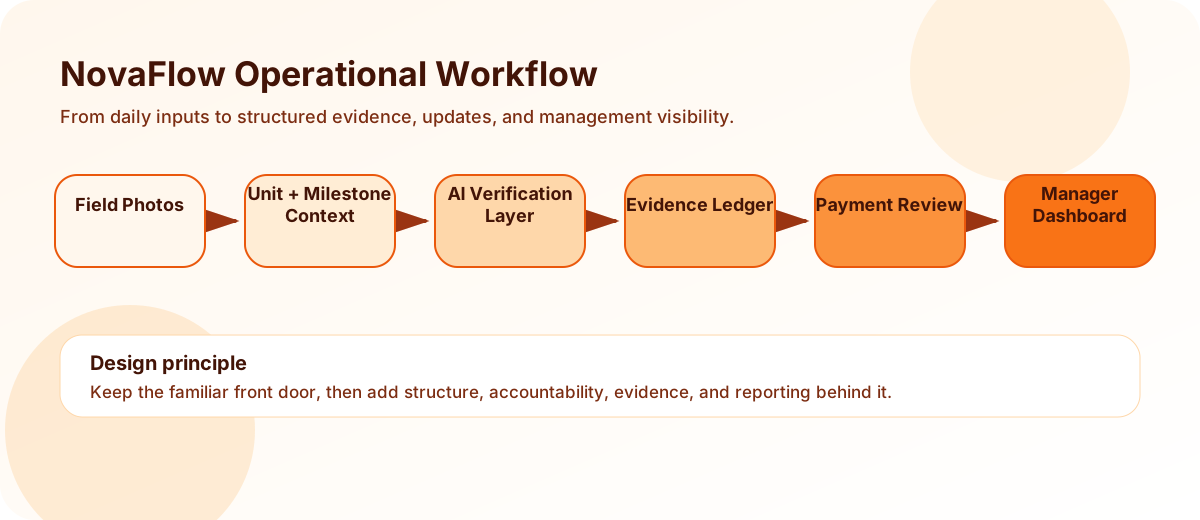
A better design captures the photo, extracts context, stores it in an evidence ledger, links it to unit and milestone, and lets managers search by project, block, contractor, stage, or claim period.
That turns daily reporting into a project memory instead of a scrolling conversation.
What NovaFlow would build first
NovaFlow would start with a practical pilot for one cluster project: photo intake, unit tagging, milestone checklist, AI-assisted classification, evidence status, supervisor review, and a dashboard for pending verification.
The first version should not try to replace a full construction management system. It should solve one painful workflow: daily progress photos become searchable, comparable, and useful for milestone review.
Once stable, the product can expand into vendor scorecards, payment claim packs, delay risk signals, handover defect lists, and owner-facing progress summaries.
The outcome is stronger project control
A Site Photo Progress Verifier gives developers and contractors a clearer way to manage many units at once. It reduces blind trust in scattered updates and creates a more disciplined evidence layer around site progress.
Managers spend less time scrolling. Supervisors know what evidence is missing. Finance can review payment claims with better context. Contractors get a clearer path to prove completed work.
That is the right role for agentic AI in construction operations: not replacing field judgment, but making daily evidence easier to verify, organize, and act on.