Turning Packing Scans into Searchable CCTV Evidence
How a capture layer can connect barcode scans, NVR timestamps, and video clips so warehouse teams can investigate packing disputes without browsing hours of CCTV footage.
The warehouse does not only need footage. It needs searchable evidence.
Most warehouses already have cameras. They record packing tables, loading areas, receiving zones, and storage aisles. But when a dispute appears, the video usually becomes difficult to use.
A customer says an item was missing. A supervisor wants to confirm whether a box was sealed correctly. A packing team needs to review what happened during one specific transaction. The footage may exist, but the team still has to search through a long CCTV timeline manually.
That is the real problem: the video is not connected to the operational identity of the shipment. The barcode knows the parcel. The CCTV knows the scene. The missing layer is the system that connects both.
A barcode scan can become the start of a video event
A practical capture system does not need to change the packing team’s behavior too much. It can use a workflow the team already understands: scan the barcode or receipt number.
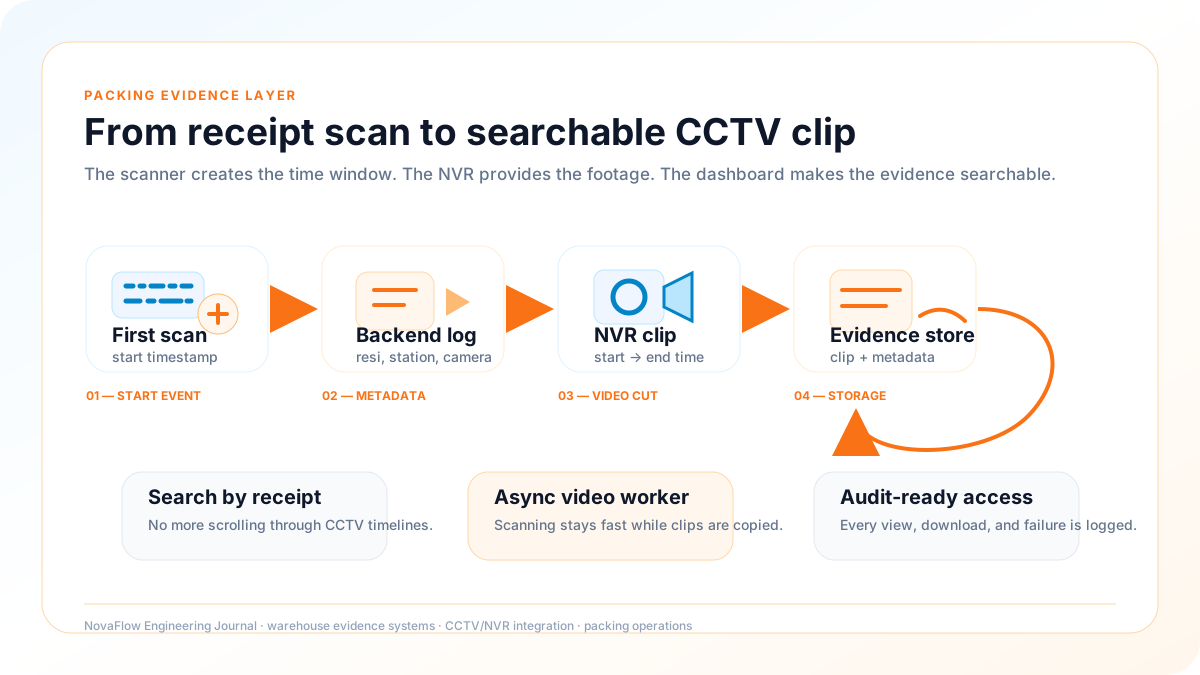
When the operator starts packing, the first scan creates the start event. The backend records the receipt number, timestamp, packing point, operator if available, and the camera channel mapped to that station.
The operator then continues the normal packing process. The system does not need to interrupt the flow with a complicated form. The important data is already captured from the scan and the station mapping.
The second scan closes the evidence window
When packing is completed, the operator scans the same barcode again. That second scan becomes the end event. Now the system has the most important information: which parcel was packed, when the process started, when it ended, and which camera should contain the footage.
This creates a clean time window for the NVR. Instead of asking someone to search from 10:00 to 11:00 manually, the backend can request the exact segment: for example, from 10:38:00 to 10:42:15 on Packing Station 01.
The result is a much more useful evidence trail. The warehouse is no longer storing generic video. It is storing video that is attached to a searchable operational record.
Turn packing start into structured metadata.
The first scan records receipt number, timestamp, station, operator, and camera channel.
Close the time window cleanly.
The second scan gives the backend the exact end time needed to request the right CCTV clip.
Review by receipt instead of by timeline.
Supervisors can search the receipt number and open the relevant evidence clip without browsing hours of footage.
The backend is the evidence brain
The capture backend is not just a small logging service. It is the evidence brain of the system.
It receives scan events, validates the barcode, stores the start and end timestamps, maps the packing point to the correct camera, sends a request to the NVR, tracks whether the clip export succeeded, and keeps the metadata ready for dashboard search.
That metadata matters as much as the video file. Without metadata, the clip becomes another file in storage. With metadata, the clip becomes evidence that can be searched, audited, reviewed, and linked to operational disputes.
type PackingEvidence = {
  barcodeNo: string
  packingPointId: string
  cameraChannelId: string
  operatorId?: string
  startTime: string
  endTime?: string
  status: 'started' | 'completed' | 'copying' | 'ready' | 'failed'
  videoPath?: string
  errorMessage?: string
}
NVR integration is where the system becomes real
The most important technical dependency is the NVR or CCTV recording system. The backend needs a way to request or extract video based on camera channel and time range.
The cleanest path is an NVR API or vendor SDK. If that is not available, the implementation may need another adapter: file-level access, FTP export, scheduled worker, or an RTSP recording pipeline controlled by the capture system itself.
This is why technical assessment matters before production rollout. The software workflow is simple conceptually, but the exact integration path depends heavily on the NVR capability, camera setup, network access, timestamp sync, and storage design.
Dedicated cameras make the evidence credible
A packing evidence system is only as useful as the camera angle. If the camera is too far, blocked by operators, or pointed at the wrong table, the system may record a clip that is technically correct but operationally weak.
Each packing point should ideally have a dedicated fixed camera. The full packing surface should be visible. Lighting should be stable. The box, items, hands, and label area should be clear enough for review.
This does not mean every deployment needs expensive new hardware. But it does mean camera placement is part of the system design, not an afterthought.
Video copying should be asynchronous
The scan experience must stay fast. Operators should not wait for video cutting or NVR export to finish before they can continue working.
A better design is asynchronous. The scan event is saved immediately. A worker process then requests the clip from the NVR, copies it to the evidence storage, updates the status, and retries if something fails.
This makes the workflow operationally safe. The packing team continues working, while the system handles the heavier video task in the background.
const flow = {
  scanStart: 'save metadata immediately',
  scanEnd: 'close time window',
  worker: 'request NVR clip asynchronously',
  storage: 'save evidence file and update status',
  dashboard: 'search by barcode when ready'
}
Storage design should follow the evidence policy
Storage should not be treated as a dumping ground. The system needs a clear retention policy: how long clips are kept in full quality, when they are compressed or archived, and which evidence must be retained longer due to dispute or audit status.
The folder structure should be predictable, but the dashboard should rely on database metadata rather than scanning file paths manually. A useful pattern is to organize by date, packing station, and receipt number, while storing searchable metadata in the database.
This allows the system to scale from a few packing points to many stations without turning evidence retrieval into a file-management problem.
Auditability is not optional
Packing evidence can become sensitive operational data. It may show staff behavior, customer items, packaging mistakes, or internal process weaknesses. That means access should be controlled.
The dashboard should require login. Video playback and download should be role-based. Every access should be logged: who opened the clip, who downloaded it, when the NVR request was made, and whether the export succeeded or failed.
This turns the system into a proper evidence platform, not just a folder of clips.
The target is faster investigation and better accountability
The success metric is not “we have more video.” The success metric is faster investigation.
If a supervisor can search a receipt number and open the exact packing clip in seconds, the operation changes. Disputes become easier to resolve. Repeated packing mistakes become easier to analyze. Teams can review process quality without manually scrolling through surveillance footage.
That is the value of a packing video capture system: it turns CCTV from passive recording into operational evidence. A barcode scan becomes the key. The NVR provides the footage. The capture layer makes the truth searchable.