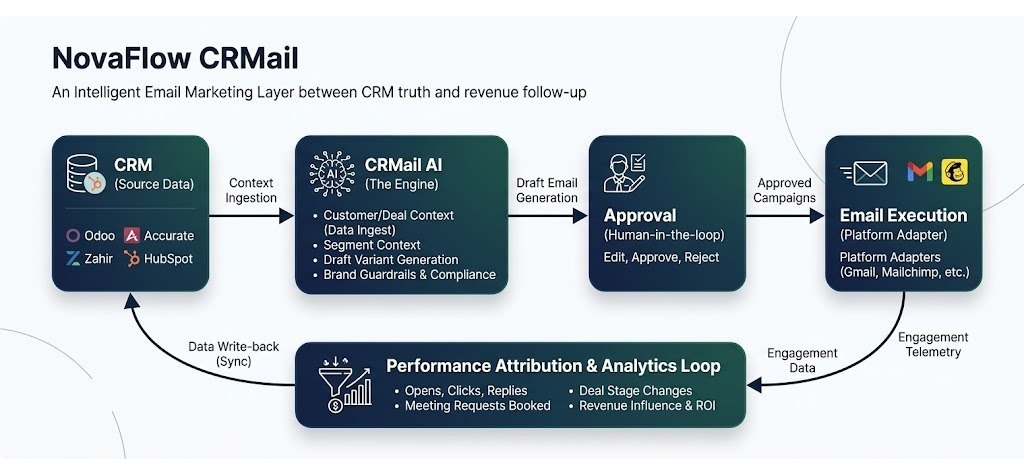
NovaFlow CRMail: The AI Layer Between CRM and Email Revenue
How NovaFlow CRMail turns underused CRM data into personalized email drafts, governed campaign workflows, and revenue attribution for Indonesian businesses.
The CRM already knows more than the email does
Many Indonesian businesses have already invested in CRM or ERP systems. Odoo stores leads and quotations. Accurate and Zahir hold customer and transaction context. HubSpot, Zoho, Salesforce, and custom systems track lifecycle stages, deal values, owners, and follow-up history.
But the email layer often ignores most of that intelligence. Campaigns are still sent as broad newsletters, lists are exported manually, personalization stops at first name, and reporting rarely connects opens or clicks back to pipeline movement.
That gap is where revenue leaks. The business has data, but the campaign still behaves like it does not. NovaFlow CRMail is designed to close that gap.
CRMail is not another CRM
CRMail is an AI intelligence layer between the CRM and the email platform. It does not try to replace Odoo, Accurate, Zahir, HubSpot, Zoho, Salesforce, Mailchimp, Gmail, or whatever stack the business already uses.
Its role is narrower and more useful: read the CRM context, generate relevant email drafts, help the team review and approve the message, push the campaign into the sending workflow, and connect engagement back to the customer or deal record.
The practical promise is simple: the CRM knows who they are. CRMail helps the team decide what to say next.
The real problem is batch-and-blast operations
Most email marketing problems are not copywriting problems. They are operating model problems. A team exports a static list, cleans it in a spreadsheet, writes one generic message, sends it to everyone, then measures surface metrics like opens and clicks.
That workflow creates two weaknesses. First, the message is not relevant enough because it ignores sales stage, purchase history, industry, last interaction, quotation value, or inactivity. Second, management cannot easily tell whether the campaign actually influenced deals, not just whether people opened the email.
AI becomes valuable only when it is connected to the CRM facts and the business workflow around approval, sending, and attribution.
What a useful CRM-email layer should do
Read the stack the business already uses.
Connect to Odoo, Accurate, Zahir, HubSpot, Zoho, Salesforce, or custom REST APIs so campaigns are based on real customer and deal data instead of stale exports.
Turn customer context into relevant copy.
Generate drafts using contact profile, company type, purchase history, lifecycle stage, deal size, and recent engagement. No generic one-template blast.
One campaign, multiple useful variations.
Create tailored variants per segment: new lead, dormant customer, quote requested, renewal candidate, high-value prospect, or industry-specific group.
AI drafts. The team decides.
Keep humans in control before external messages are sent. Sensitive pricing, claims, discounts, and compliance language stay reviewable.
Measure business impact, not vanity metrics.
Track replies, clicks, meetings, quote requests, deal movements, and revenue influence back inside the CRM where leadership already reviews pipeline.
A real example: the seven-day quotation nudge
Imagine a B2B distributor using Odoo. A prospect requested a quotation seven days ago, but there has been no follow-up. Without a structured layer, the sales or marketing team exports the lead list, filters dates in Excel, writes a generic reminder, sends it manually, and hopes someone replies.
With CRMail, the team selects a segment: quote requested, seven days no follow-up. The system pulls contact name, company, industry, quote value, product interest, and account owner from the CRM. Then it drafts several options: a professional follow-up, a warmer consultative note, or a more urgency-oriented reminder.
The team reviews the draft, edits if needed, approves the send, and CRMail logs the engagement back to the CRM. If the prospect clicks or replies, the account owner gets context. If the deal moves, management can see that the campaign influenced pipeline rather than just generating an open rate.
The implementation pattern is workflow-first
A serious CRMail deployment should not start with a giant AI prompt. It should start with workflow mapping: which CRM is used, which fields are reliable, which lifecycle events matter, who approves campaigns, what email platform sends the message, and what attribution should be written back.
Once that operating model is clear, the technical layer is straightforward: connector, segmentation query, prompt context builder, draft generator, approval queue, send adapter, engagement webhook, and attribution writer.
This separation matters because AI text generation is only one part of the product. The value appears when the text is connected to clean data, governed approval, and measurable business outcomes.
type CRMailCampaign = {
  segment: string
  crmSource: 'odoo' | 'accurate' | 'zahir' | 'hubspot' | 'zoho' | 'salesforce' | 'custom_api'
  contextFields: string[]
  draftVariants: Array<{ tone: 'professional' | 'casual' | 'urgency'; body: string }>
  approvalStatus: 'draft' | 'approved' | 'rejected'
  sendPlatform: string
  attribution: Array<'reply' | 'click' | 'meeting_booked' | 'deal_created' | 'stage_changed'>
}
Why local CRM support matters in Indonesia
Many AI email products are built around the US and EU software stack. They assume HubSpot or Salesforce, English-first content, and a marketing operations team that already works inside a mature automation platform.
Indonesian businesses often look different. Odoo is common. Accurate and Zahir matter. Custom internal systems matter. Many teams still run parts of the workflow through spreadsheets, WhatsApp, Gmail, and ad-hoc exports.
That is why CRMail should be CRM-agnostic by design. The system must meet the business where the data already lives instead of forcing a full replacement before value appears.
Pricing should match adoption maturity
A practical product path starts with clear tiers. Starter fits small teams that want a few AI-assisted campaigns per month. Growth supports larger contact lists and recurring segmentation. Scale fits teams that want unlimited campaign workflows and deeper attribution. Enterprise covers custom connectors, on-premise deployment, stricter data boundaries, and advanced governance.
The important commercial point is that CRMail is not sold as magic copywriting. It is sold as marketing operations leverage: less manual writing, fewer stale lists, more relevant follow-up, and clearer revenue connection.
For many teams, the first paid value can come from setup services: CRM integration, custom workflow design, email playbook creation, and team training. The subscription then keeps the layer running month after month.
Governance protects the brand
Email is an external action. That means governance is not optional. AI may draft the message, but the system should preserve approval flow, brand voice, unsubscribe compliance, suppression lists, sensitive claims review, and audit logs.
Human-in-the-loop is not a weakness. It is how businesses safely use AI in customer-facing communication. The goal is not to remove marketing judgment. The goal is to remove repetitive draft work and give the team better starting points grounded in real CRM context.
const policy = {
  generateDraft: 'auto_allowed',
  useCustomerData: 'approved_fields_only',
  sendCampaign: 'human_approval_required',
  pricingDiscountClaim: 'manager_review_required',
  writeBackToCRM: 'audit_logged'
}
What NovaFlow would build first
The first CRMail deployment should be deliberately focused. Pick one CRM, one lifecycle segment, one email platform, and one measurable revenue objective. For example: revive dormant customers, follow up quotations, nurture demo requests, or reactivate abandoned leads.
From there, NovaFlow would build the connector, map the fields, define the campaign approval flow, generate the first draft variants, and write engagement outcomes back to the CRM. A working pilot should show useful personalization with real data in days, not months.
That is the right shape for AI adoption: narrow enough to deploy quickly, structured enough to be trusted, and measurable enough for leadership to decide whether to expand.
The strategic shift is from email blasts to revenue conversations
The future of email marketing is not more newsletters. It is better-timed, better-contextualized business communication based on the data companies already own.
CRMail gives that data a practical execution layer. It helps teams move from static lists to live segments, from generic templates to contextual drafts, from vanity reporting to pipeline attribution, and from disconnected marketing activity to revenue-aware follow-up.
NovaFlow CRMail is an NDF product concept by NovaFlow™: the CRM keeps the truth, the email platform sends the message, and the AI layer helps the team say the right thing with control.