NFVision for Smart Traffic Monitoring and Road Intelligence
How AI vision can turn standard CCTV feeds into real-time vehicle classification, ALPR, traffic KPIs, congestion analysis, and smarter road operations.
Road cameras should do more than record congestion
Most cities, industrial estates, campuses, ports, and commercial areas already have cameras pointed at roads, gates, intersections, parking entrances, and logistics lanes. But too often, those cameras are still treated as passive surveillance.
They can show what happened, but they do not automatically explain what is happening: how many vehicles passed, what type of vehicles dominate, whether the flow is getting worse, where queues are forming, or when peak pressure starts.
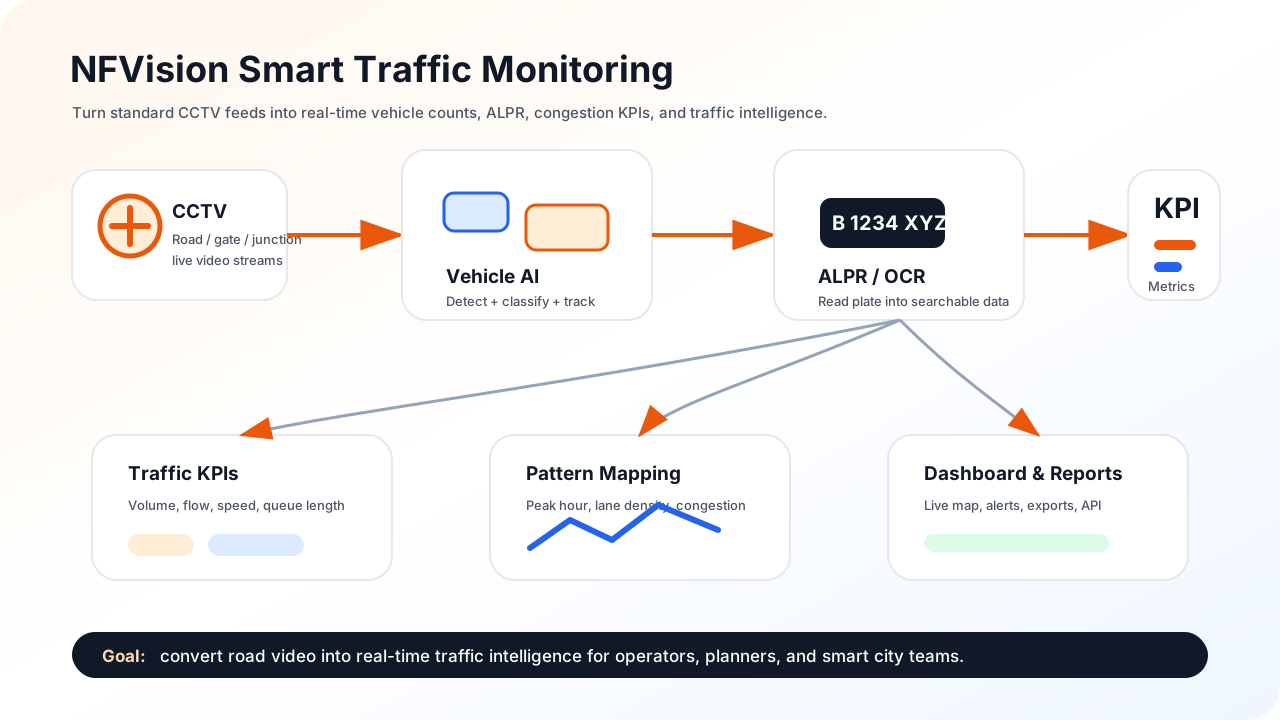
NFVision changes the role of the camera. It turns live road video into structured traffic intelligence that operators, planners, and management can actually use.
The first layer is vehicle detection and classification
A smart traffic system should understand the difference between cars, motorcycles, buses, trucks, and other vehicle classes. This matters because traffic volume alone is not enough. A road dominated by motorcycles behaves differently from a road dominated by trucks.
With AI vision, every detected vehicle can be counted, classified, and tracked as it moves through the camera frame. The system can then produce cleaner statistics: volume by vehicle type, direction of movement, lane usage, and time-based patterns.
This is the foundation. Once the system can see vehicles reliably, it can begin to measure traffic behavior.
Know traffic volume without manual counting.
NFVision can count vehicles by class, lane, direction, and time window, creating a live operational picture from standard camera feeds.
Turn plates into searchable traffic data.
Automatic License Plate Recognition reads plate numbers from camera images and connects them to access, security, tolling, or investigation workflows.
Measure queue, density, and flow before complaints arrive.
Instead of waiting for human observation, the system can surface queue length, average speed, density, and congestion level in near real time.
ALPR adds identity to the traffic layer
ALPR means Automatic License Plate Recognition. It uses computer vision and OCR to read vehicle plates from camera images and convert them into searchable structured data.
This is useful for many workflows: access control, security review, tolling support, vehicle history, blacklists/whitelists, visitor records, or incident investigation. In a logistics or industrial area, ALPR can also help track truck entry and exit with better evidence than manual logs.
The key is not just reading the plate. The key is connecting the plate to the right operational rule.
Traffic KPIs should be generated automatically
A good traffic dashboard should not rely on someone watching video all day. It should automatically generate KPIs: vehicles today, vehicle types, current flow, average speed, congestion level, queue length, and peak-hour patterns.
These metrics are not just nice charts. They help operators understand whether a road is smooth, building pressure, or already overloaded. They help management see whether a gate, lane, intersection, or access point is becoming a bottleneck.
Over time, the same data can support better staffing, traffic light timing, lane planning, parking access rules, and site logistics decisions.
Object tracking prevents double counting
If a vehicle appears in several frames, the system should not count it again and again. Object tracking gives the vehicle a temporary digital identity while it moves through the camera view.
This matters because accurate counting is the difference between a useful traffic system and a noisy dashboard. Tracking helps the system understand movement direction, crossing lines, dwell time, and whether the same vehicle has already been counted.
For busy roads, tracking is just as important as detection.
Historical traffic patterns become planning intelligence
Real-time monitoring is useful, but historical data is where planning becomes stronger. Once the system has enough history, it can show peak hours, recurring congestion windows, unusual spikes, lane pressure, vehicle mix, and seasonality.
This changes the conversation from “the road feels crowded” to “traffic volume increases 32% between 07:00 and 09:00, motorcycles dominate the morning flow, and queue length grows fastest near the entry gate.”
That is the kind of data that supports better decisions.
Where NFVision can be applied
The use case fits smart city roads, industrial estates, factory gates, ports, campuses, hospitals, malls, residential complexes, toll support areas, and logistics yards.
Each site has different needs. A city may care about congestion and traffic signal planning. A factory may care about truck queues and gate access. A campus may care about peak-hour flow and parking pressure. A logistics yard may care about truck dwell time and entry/exit evidence.
NFVision should adapt to the operating environment instead of forcing one generic traffic template.
Start with a focused pilot
A strong pilot can start with one road segment, one gate, or one intersection. The goal is to prove camera quality, vehicle classification, ALPR accuracy, counting logic, dashboard usability, and reporting value.
The first pilot should answer practical questions: Can the camera see plates clearly? Are vehicles counted once? Does classification work at the required distance? Does the dashboard show useful KPIs? Are alerts relevant?
Once the pilot is stable, the system can expand across more cameras and more traffic workflows.
The goal is calmer, data-driven traffic operations
Traffic monitoring should not create more noise for operators. It should create clarity: what is happening, where it is happening, how serious it is, and what should be reviewed.
NFVision helps turn road video into a measurable operating layer. It can count vehicles, classify flow, read plates, detect congestion, map patterns, and produce reports without forcing teams to manually inspect every feed.
That is the value of AI in traffic monitoring: better visibility, better evidence, and better decisions before road problems become daily frustration.