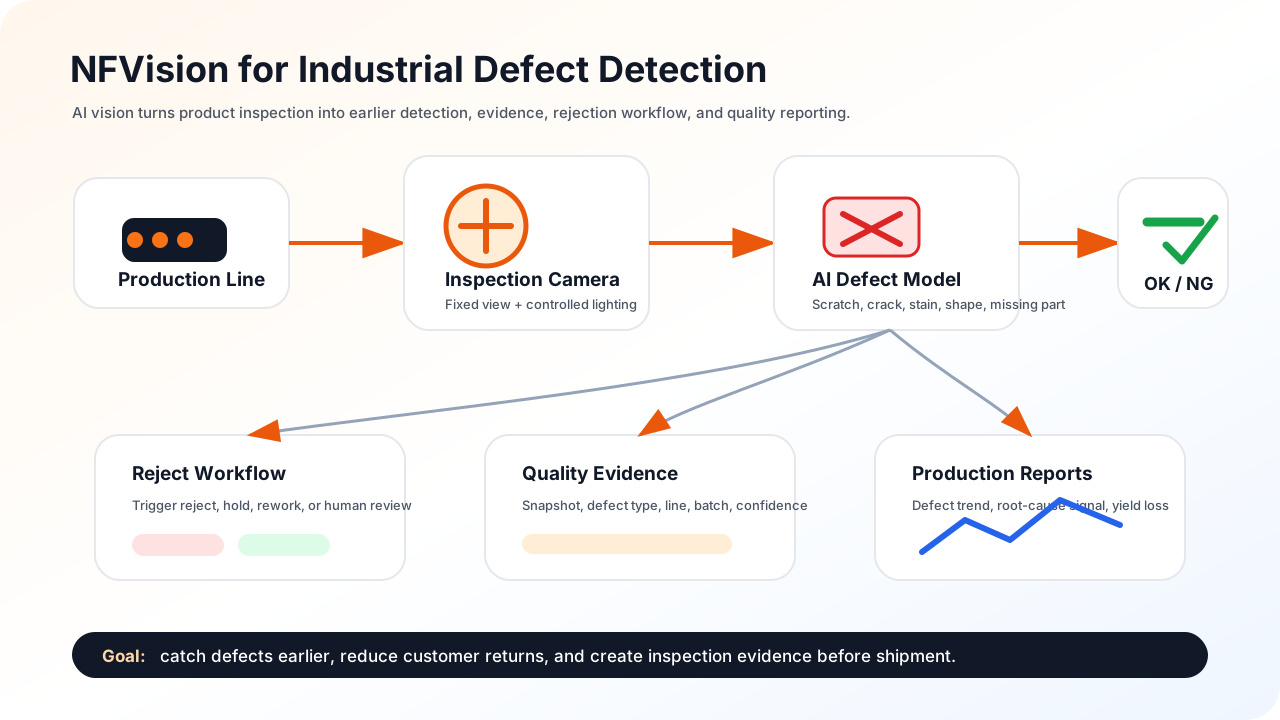
NFVision for Industrial Automation and Product Defect Detection
How AI vision can help factories detect defects earlier, prevent quality escapes, reduce production loss, and protect customer trust before products leave the line.
The most expensive defect is the one that reaches the customer
In manufacturing, defects do not only cost material. They cost rework time, shipment delay, claim handling, customer trust, and sometimes the next order. A small scratch, missing component, wrong shape, stain, label issue, or visual inconsistency can become much more expensive after it leaves the factory.
Traditional inspection depends heavily on human attention. That works in many cases, but it becomes difficult when the line is fast, the volume is high, the defects are subtle, or the inspection rule must be applied consistently across shifts.
NFVision is designed to add an AI vision layer to that process: helping factories detect visible defects earlier, capture evidence automatically, and reduce the risk of defective products being shipped to customers.
AI vision should focus on real production losses
The value of defect detection is not “AI can see things.” The value is preventing specific quality escapes that already create cost. That means the model should be trained around the defects that matter to the operation.
Examples include surface scratches, cracks, stains, wrong orientation, missing parts, incomplete assembly, incorrect label placement, damaged packaging, color inconsistency, dimension-related visual anomalies, or abnormal product shape.
Each factory has its own defect language. NFVision should learn that language instead of forcing a generic template onto the line.
Catch visible quality problems before shipment.
Scratches, stains, dents, cracks, marks, contamination, or finishing defects can be detected when the camera view and lighting are controlled properly.
Check whether the required component is present.
AI vision can help flag missing labels, missing parts, wrong orientation, incorrect placement, or incomplete assembly before the item moves downstream.
Every quality exception should leave a record.
Snapshot, defect type, confidence score, batch, line, timestamp, and operator review create a stronger quality trail for continuous improvement.
The camera is only the beginning
A camera alone does not improve quality. It only captures images. The real system needs inspection logic: what to detect, where to look, when to classify, when to reject, when to ask for human review, and how to record the event.
This is why NFVision combines camera ingestion, AI model, inspection zone, rule engine, evidence storage, dashboard, and reporting. The model is important, but the workflow around the model is what turns detection into operational value.
A defect event should not disappear as a red box on a screen. It should become a traceable quality event.
Controlled lighting and placement matter more than people expect
Industrial defect detection often fails when the camera setup is treated casually. Reflection, shadow, vibration, motion blur, angle, product speed, and background noise can all affect model performance.
The strongest setup usually uses fixed camera positions, consistent lighting, clear inspection zones, and a stable product presentation. The easier it is for a human to see the defect clearly in the image, the easier it is to train a reliable AI model.
In many projects, improving the camera and lighting setup creates more value than simply choosing a larger model.
From detection to reject workflow
Once a defect is detected, the system needs a response path. Depending on the line, NFVision can support different actions: visual alarm, operator review, reject signal, hold-for-inspection status, rework routing, or quality report generation.
For high-speed lines, the reject action needs careful integration with the production equipment. For lower-speed or manual processes, a dashboard alert and evidence workflow may be enough for the first pilot.
The right design depends on the process risk, product value, line speed, and how expensive a false reject or missed defect would be.
type DefectEvent = {
  lineId: string
  cameraId: string
  productId?: string
  defectType: 'scratch' | 'crack' | 'stain' | 'missing_part' | 'wrong_orientation' | 'unknown'
  confidence: number
  decision: 'pass' | 'reject' | 'human_review'
  evidenceImage: string
  timestamp: string
}
Quality data becomes a management asset
The same system that detects defects can also help management understand patterns. Which defect appears most often? Which line has the highest reject rate? Which shift sees more anomalies? Which product batch needs review? Which camera needs recalibration?
This is where AI vision becomes more than a line-side tool. It becomes part of quality intelligence. The factory gets not only an alert, but also a data layer for continuous improvement.
Over time, this data can support root-cause analysis, supplier review, maintenance planning, process tuning, and customer-claim investigation.
A practical pilot should start narrow
The best first pilot is not “detect every defect.” It is one product, one inspection point, and a small set of high-value defect classes. Start where a missed defect is already expensive or where human inspection is most inconsistent.
A practical pilot can include camera setup, dataset collection, defect labeling, AI model training, dashboard, event log, and a simple reject or review workflow. The goal is to prove that the system can detect the right issue under real production conditions.
After that, the system can expand to more products, more defect types, more cameras, and deeper integration with production systems.
The goal is fewer quality escapes
NFVision does not replace a quality team. It gives the quality team better eyes, better evidence, and a more consistent inspection layer.
For factories, the commercial value is straightforward: fewer defective products reaching customers, less manual review burden, better evidence during claims, and clearer visibility into where production loss is happening.
That is the right way to use AI in industrial automation: not as a gimmick, but as a practical layer that helps the factory detect earlier, respond faster, and improve continuously.