Agentic AI for Hotel Operations and Guest Service
How NovaFlow can build an agentic AI system for hotels that connects guest requests, front office work, housekeeping, maintenance, billing context, and management visibility.
Hotels do not need another disconnected dashboard
A hotel is a live operation. Guests ask for WiFi help, towels, late checkout, room service, AC repair, billing clarification, transport, and local recommendations at different hours through different channels.
When those requests live in separate chats, notebooks, phone calls, and staff memory, service quality depends too much on who happens to be awake and who remembers the last update.
This is where agentic AI becomes useful. Not as a fancy chatbot. As an operational layer that keeps context, asks for missing details, routes work to the right team, follows up, and gives management a clearer view of what is happening across the property.
What we mean by agentic AI for hotels
Agentic AI is not just a chat window on a website. A normal chatbot waits for a question and gives an answer. An agentic system can understand intent, check context, call tools, update records, trigger workflows, and continue the job until it reaches a useful state.
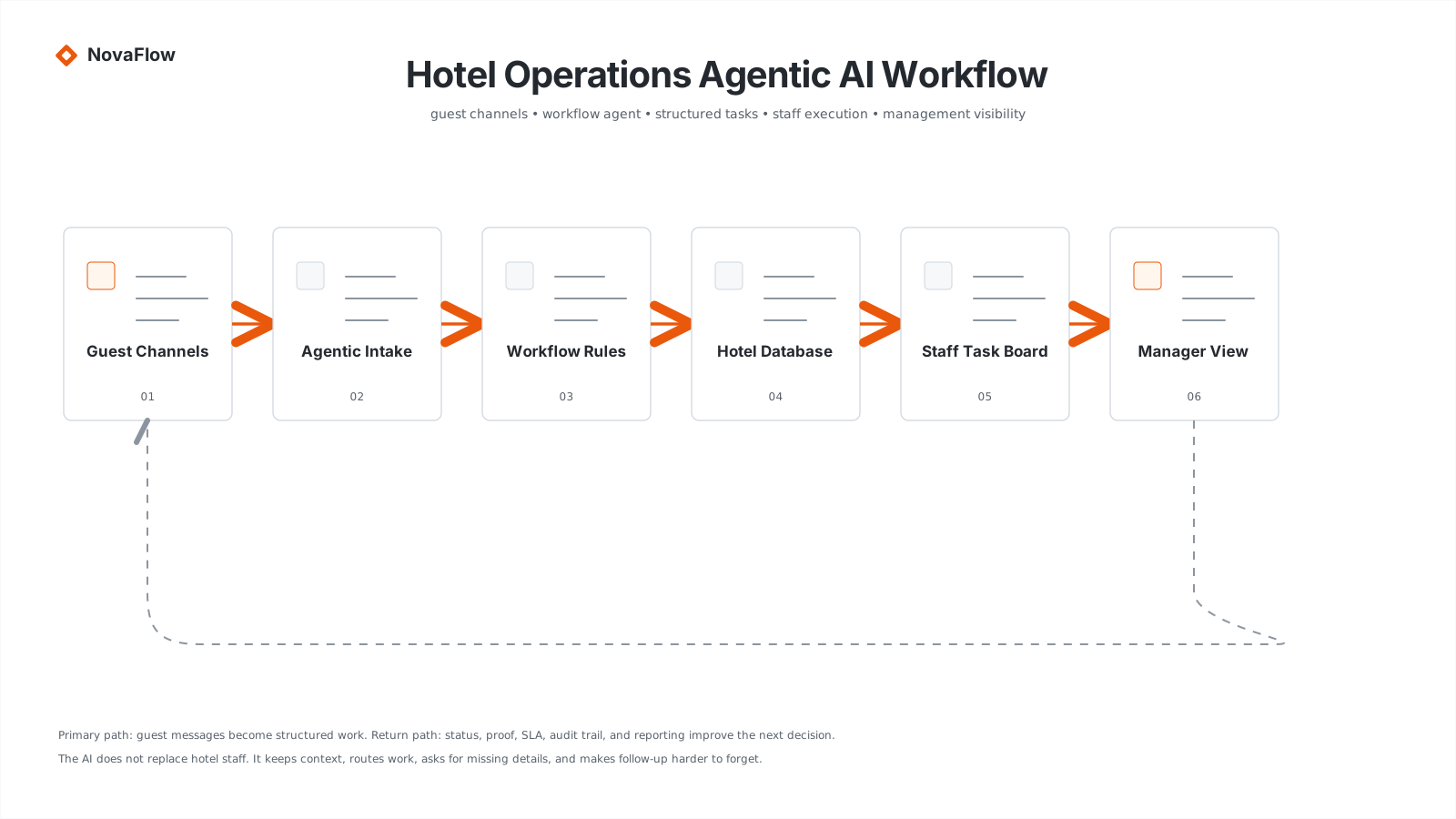
For a hotel, that means a guest message can become a real operational task. A complaint can become a ticket. A WiFi issue can go to IT. A towel request can go to housekeeping. A late checkout request can ask front office for approval. A recurring AC issue can appear in the manager report.
The guest still experiences a simple conversation. Behind that conversation, the system is doing structured work.
The first value is cleaner guest request handling
Most hotels already have the raw material for automation: WhatsApp conversations, front desk notes, guest calls, housekeeping requests, maintenance updates, and daily manager briefings.
The problem is that the information is not structured. A message like “the AC is not cold again” may contain a room issue, a recurring maintenance problem, a guest satisfaction risk, and a possible compensation discussion. A human understands the message, but the system often sees nothing.
An agentic AI layer turns that message into useful structure: room number, issue category, urgency, assigned department, guest status, previous related issues, and next action. That is the difference between chat noise and hotel operations data.
Front office becomes the coordination layer
Front office is not just a reception desk. In many hotels, it is the coordination center for guest requests, room status, late checkout, billing questions, lost items, complaints, and escalation.
A good system should help front office see what is open, what is waiting, who owns the next step, and which guest needs attention. It should reduce the need to ask “has this been handled?” every few minutes.
For example, if a guest asks for late checkout, the agent can collect the room number, check the guest profile, prepare the request, and route it to front office or manager approval. If approved, it can update the task, notify the guest, and keep the decision in the log.
Housekeeping and maintenance need simple task flow
The system should not make staff fight with complicated software. Housekeeping and engineering teams need simple, clear tasks: what room, what issue, what priority, what proof is needed, and when it must be updated.
A towel request, make-up-room request, AC issue, leaking sink, or WiFi problem should have a visible status. New. Assigned. In progress. Waiting parts. Done. Confirmed. This is not bureaucracy. It is how the hotel prevents forgotten work.
When every request has a status, managers can finally see where operations are stuck. Not from rumors. From the workflow.
The AI should not replace hotel judgment
Hospitality is human. A guest complaint, room upgrade, refund, discount, or sensitive billing issue should not be handled blindly by AI.
The right design is human-in-the-loop. The agent prepares context and options. A manager or front office staff makes the decision. The system then records what was decided and continues the workflow.
This protects both the guest experience and the hotel. The AI handles repetitive coordination. Humans keep judgment, empathy, and final approval where it matters.
Management gets better visibility without chasing staff
A hotel manager should not need to open five chat groups to understand the day. The system should show open guest requests, overdue tasks, repeated room issues, departments under pressure, unresolved complaints, and key service patterns.
This is especially useful for recurring issues. One AC complaint may be normal. Three AC complaints from the same room in two weeks is a pattern. The system can surface that pattern before it becomes a bad review.
The same applies to WiFi complaints, slow housekeeping response, repeated billing confusion, or delayed maintenance. Agentic AI is useful because it remembers what the operation forgets.
What NovaFlow can build for a hotel
NovaFlow can build the system around the hotel’s actual workflow, not around a generic software template. The first step is mapping how the property currently handles guest messages, front office approval, housekeeping, maintenance, billing questions, reports, and escalation.
From there, we can build a pilot system with guest intake, staff task board, room status, ticket tracking, basic reporting, and management visibility. Integrations can come later: PMS, POS, payment gateway, WhatsApp Business API, door lock, accounting, or channel manager.
The important point is sequencing. We do not need to replace every system on day one. We start with the operational bottleneck that creates the most daily friction, make it trackable, and expand from there.
A practical pilot can start small
A strong first pilot does not need to cover the entire hotel. It can start with three workflows: guest request intake, housekeeping task tracking, and maintenance ticket escalation.
That alone gives the hotel a visible improvement: fewer forgotten requests, faster follow-up, cleaner handover between shifts, and a daily report that managers can actually use.
Once the team trusts the workflow, the system can expand into front office approvals, billing context, room service, promo broadcast, guest feedback, and AI-assisted manager briefing.
The goal is not more software. The goal is calmer operations.
Hotels already run under pressure. Adding another heavy platform will not help if staff do not use it. The system has to feel natural: guest messages in familiar channels, staff tasks that are easy to update, managers seeing the situation without chasing people.
Agentic AI works when it sits quietly in the middle of the operation: listening, structuring, routing, reminding, summarizing, and escalating when needed.
That is the kind of hotel system NovaFlow can build: not a generic chatbot, but an operational AI layer that helps the hotel serve guests better and run the property with more control.