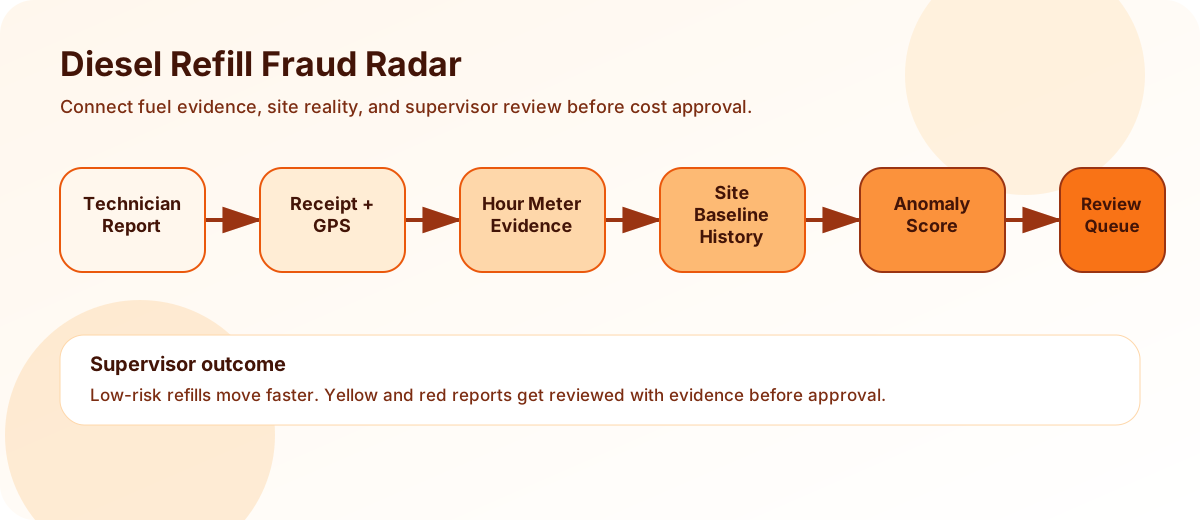
Diesel Refill Fraud Radar for Remote Tower and Genset Maintenance
How field-service contractors can reduce diesel leakage by connecting refill receipts, genset hour meters, technician GPS, site schedules, and anomaly scoring into one evidence workflow.
Diesel cost often leaks quietly in remote operations
For tower maintenance teams, remote genset vendors, and field-service contractors, diesel is not a small side cost. It is a recurring operational expense that moves through many hands: technicians, SPBU receipts, site visits, genset hour meters, supervisor approvals, and monthly client reports.
The difficult part is that leakage rarely appears as one obvious incident. It appears as small differences: a refill that seems slightly too high, a receipt that is hard to verify, a site that consumes more fuel than similar sites, or a technician route that does not match the claimed refill location.
By the time management sees the monthly number, the evidence is already scattered across WhatsApp photos, spreadsheets, manual reports, and memory. A Diesel Refill Fraud Radar turns those scattered traces into a structured review workflow.
The problem is not only fraud. It is weak evidence.
It is tempting to frame every diesel mismatch as technician fraud. That is too simplistic. Some issues come from real site conditions: longer outages, generator inefficiency, road delays, emergency visits, wrong meter reading, or poor documentation habits.
The business problem is evidence quality. When a supervisor cannot quickly compare refill volume, genset runtime, site baseline, route location, and photo proof, every approval becomes a guess.
A good system does not start by accusing people. It starts by making the field process clearer: what was refilled, where, when, by whom, with what proof, and whether the amount makes sense against the site history.
What the radar should connect
The first version can stay focused. Every refill report should include site ID, visit date, refill volume, amount paid, receipt photo, genset hour meter before and after, optional tank photo, technician identity, and GPS check-in.
The platform then compares that claim against expected consumption for the site. If the genset hour meter barely moved but the refill claim is high, the system should flag it. If the receipt location is far outside the normal route, the system should flag it. If the same site or technician repeatedly creates unusual claims, the system should surface the pattern.
This turns fuel review from manual suspicion into operational signal.
Capture refill proof at the source.
Technicians submit receipt photos, hour meter photos, volume, amount, notes, and GPS check-in from the field.
Compare the claim against site reality.
The system checks historical consumption, genset runtime, route logic, missing evidence, and repeated patterns.
Review exceptions instead of every receipt.
Supervisors focus on yellow and red reports while normal refills can move through faster approval.
A practical anomaly score
The scoring does not need to be complicated in the beginning. It can combine several simple signals: volume deviation from the site baseline, mismatch between refill volume and hour meter movement, missing photos, GPS distance from site or expected SPBU, unusually frequent refills, and repeated exception history.
Each report receives a status such as low risk, review needed, or high risk. The goal is not to let software make the final accusation. The goal is to help supervisors decide where to look first.
This is especially useful when the company manages dozens or hundreds of remote sites. Without scoring, every receipt looks equally urgent. With scoring, attention goes to the reports that deserve review.
type FuelRefillReport = {
  siteId: string
  technicianId: string
  refillLiters: number
  receiptPhotoUrl: string
  hourMeterBefore?: number
  hourMeterAfter?: number
  gpsCheckIn: { lat: number; lng: number }
  anomalyScore: number
  reviewStatus: 'low_risk' | 'review_needed' | 'high_risk'
}
Why this matters for tower and genset contractors
Remote asset maintenance is expensive because visibility is low. The site may be far away, the supervisor may not be present, and the client may only care whether the asset stays running. Fuel becomes one of the easiest costs to normalize and one of the hardest costs to audit.
For contractors, even a small improvement can matter. Reducing fuel leakage by five to ten percent across many sites can protect margin without adding a large audit team. More importantly, the company gains a cleaner approval trail when clients or management question the cost.
The radar also helps honest technicians. Clear evidence protects good field workers from suspicion because the report is supported by timestamp, location, meter reading, and site history.
The dashboard should show cost pressure, not only forms
A useful dashboard should answer operational questions: which sites have the highest diesel cost, which refills are waiting for review, which technicians or areas create repeated exceptions, and how much estimated leakage may exist this month.
Management should be able to see trend lines by site, region, vendor, technician, client contract, and genset type. Supervisors should see the review queue. Finance should see which fuel claims are approved, rejected, or still pending evidence.
This is how the product becomes more than a reporting form. It becomes a cost-control layer for field operations.
Start without expensive sensors, then integrate later
Some companies may eventually connect fuel sensors, IoT gateways, genset controllers, or telematics. That can improve accuracy. But the first version does not need to wait for a full hardware rollout.
A software-first pilot can begin with structured field reporting, GPS check-in, receipt capture, hour meter photos, site baseline, and supervisor review. That already improves evidence quality and creates data for future automation.
After the workflow is trusted, the product can integrate with IoT fuel level sensors, genset telemetry, route tracking, ERP approvals, or client reporting portals.
What NovaFlow would build first
NovaFlow would start with a focused MVP for one contractor or one operating region: technician mobile report, receipt and hour meter capture, GPS check-in, site baseline table, anomaly score, supervisor review board, and monthly cost dashboard.
The MVP should be simple enough for field teams to actually use. No heavy form. No complicated ERP replacement. Just a disciplined flow from refill evidence to review decision.
From there, the product can expand into route compliance, spare part usage monitoring, site profitability, maintenance proof, and broader field operations intelligence.
The business outcome is cleaner control
Diesel Refill Fraud Radar is not just a fraud tool. It is a control system for one of the most common cost leaks in remote field operations.
It gives technicians a clearer reporting process, supervisors a sharper review queue, finance a better approval trail, and management a more honest view of site-level fuel cost.
For businesses that maintain towers, gensets, remote facilities, or scattered industrial assets, that kind of clarity can quickly become a serious margin advantage.