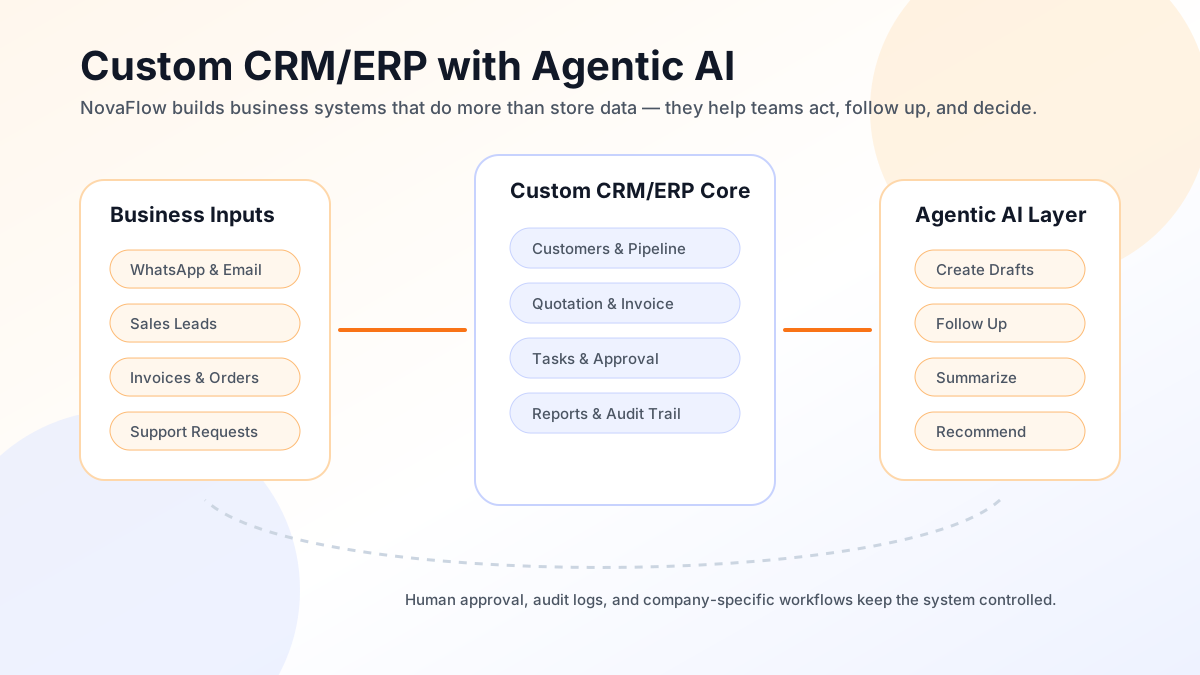
Custom CRM and ERP Systems with Agentic AI Capabilities
How NovaFlow can develop a custom CRM or ERP for your company with agentic AI capabilities that help teams follow up, create documents, summarize operations, and act on business data.
Most companies do not need another generic dashboard
Many companies already use spreadsheets, chat groups, accounting tools, sales notes, shared folders, and manual reports to run the business. The problem is not always that the team has no software. The problem is that the software does not match how the company actually works.
A sales team may need tighter lead follow-up. Finance may need better invoice visibility. Operations may need task ownership. Management may need a weekly picture of what is stuck. Customer service may need a cleaner way to turn messages into tickets.
That is why a custom CRM or ERP can be valuable. It is built around the company workflow, not around a generic template that forces every team to adapt to someone else’s process.
What changes when CRM and ERP become agentic
A traditional CRM stores customers, leads, deals, notes, and follow-up schedules. A traditional ERP stores orders, inventory, invoices, payments, projects, and approvals. These systems are useful, but they still depend heavily on humans opening screens, filling forms, checking reports, and remembering the next action.
Agentic AI adds a working layer on top of those records. Instead of only showing data, the system can help interpret the data, prepare the next step, and execute controlled actions with human approval where needed.
For example, an AI agent can summarize a customer history before a sales call, draft a quotation, create a follow-up task, detect overdue invoices, prepare a payment reminder, classify incoming support messages, or generate a weekly management brief.
The goal is not to replace your team
The best use of agentic AI is not replacing the judgment of managers, salespeople, finance teams, or operations staff. The goal is to remove repetitive coordination work and reduce the number of things that fall through the cracks.
A company still needs human approval for sensitive actions: sending final quotations, confirming payments, applying large discounts, changing stock, approving refunds, or sending messages to customers. But the AI agent can prepare the draft, collect the context, check the data, and make the decision easier.
This creates a safer operating model: AI handles repetitive preparation and structured follow-through, while humans keep control over business judgment.
Turn leads into structured follow-up.
Capture inquiries from WhatsApp, forms, or email, then create leads, opportunities, reminders, and quotation drafts automatically.
Make invoice and payment status visible.
Track outstanding invoices, aging, payment promises, reminder drafts, and finance follow-up tasks in one system.
Convert daily requests into accountable work.
Customer requests, project updates, stock movements, approvals, and internal tasks become visible workflows instead of scattered messages.
What NovaFlow can build
NovaFlow can develop custom CRM and ERP systems for companies that need a practical operating layer around their real workflow. The scope can start small or grow into a wider business system over time.
For CRM, the system can include customer database, contact records, lead management, sales pipeline, activity timeline, task reminders, quotation drafts, customer segmentation, and management reports.
For ERP-lite, the system can include product or service catalog, quotation, invoice, payment tracking, project tasks, support tickets, inventory visibility, purchase requests, approval flows, and operational dashboards. The system can also connect with existing tools instead of replacing everything on day one.
The practical starting point is usually CRM plus workflow
A full ERP can become large very quickly. Accounting, inventory costing, tax rules, warehouse control, HR, and procurement each have their own complexity. That is why many companies should not start by trying to build everything at once.
A better starting point is often CRM plus workflow: customers, leads, opportunities, tasks, quotations, invoices, and simple reporting. This already improves daily execution because the business can see who needs follow-up, what is waiting for approval, which customer has an open issue, and where revenue may be stuck.
Once that foundation is stable, the system can expand into finance, inventory, purchasing, project delivery, support, or HR depending on the company’s highest operational pain.
Agentic AI works best when it has tools, not just chat
A normal chatbot can answer questions. An agentic business system can call tools: create a lead, update a deal stage, draft a quotation, create a ticket, summarize a project, list overdue invoices, or prepare a daily report.
This matters because business value appears when AI can interact with structured company data safely. The AI agent should not guess. It should read the CRM/ERP records, use approved tools, produce auditable actions, and ask for confirmation when the action affects customers, money, stock, or legal commitments.
That is the difference between an AI demo and a real agentic AI system for company operations.
type AgenticWorkflow = {
  input: 'WhatsApp' | 'Email' | 'Dashboard' | 'API'
  intent: 'sales_lead' | 'invoice_followup' | 'support_ticket' | 'manager_report'
  tools: ['search_customer', 'create_task', 'draft_quotation', 'summarize_pipeline']
  approval: 'auto_allowed' | 'human_required'
  auditTrail: true
}
A custom system can match local business habits
Many Indonesian businesses operate through WhatsApp, spreadsheets, accounting software, manual admin routines, and owner-led decisions. A generic CRM may be too rigid, while a full ERP may be too heavy for the first step.
NovaFlow can design the system around the company’s current habits, then gradually structure them. WhatsApp can remain the front door. Spreadsheets can become import/export tools. Existing accounting or ERP platforms can remain the source of truth where needed. The custom CRM/ERP becomes the coordination layer that connects data, people, tasks, and AI-assisted execution.
This approach is often faster, less disruptive, and easier for teams to adopt.
Governance is part of the product
When AI can act on business data, governance becomes essential. Every important action should be logged. Every customer-facing message should have clear permission rules. Every financial change should be traceable. Every agent should have limited access to only the tools it needs.
For example, a Sales Agent may be allowed to create a lead and draft a quotation, but not send the final quotation without approval. A Finance Agent may list overdue invoices and draft reminders, but not mark an invoice as paid without evidence. A Support Agent may create tickets and suggest replies, but escalation rules still belong to the business.
This is how agentic AI becomes safe enough for real operations: useful automation with human control and audit visibility.
What a first pilot can look like
A strong first pilot can be completed around one high-value workflow. For a sales-driven company, that might be lead capture, sales pipeline, follow-up reminders, and quotation drafts. For a service company, it might be customer requests, ticketing, tasks, and SLA visibility. For a trading or distribution company, it might be customer orders, invoice status, stock visibility, and purchasing requests.
The pilot should not try to automate the entire company. It should prove one thing clearly: the business can turn scattered daily inputs into structured records, accountable tasks, and AI-assisted next actions.
After the team trusts the workflow, the system can expand module by module.
The business case is clearer execution
The real value of a custom CRM/ERP is not only cleaner software. It is clearer execution. The company can see the pipeline, know which invoice is overdue, track which customer needs attention, assign responsibility, preserve context, and reduce the daily dependence on memory and chat scrolling.
Agentic AI strengthens that value by helping the team move from data to action: summarize, draft, remind, classify, route, and recommend. The system becomes more than a database. It becomes an operating layer.
That is what NovaFlow can build for your company: a practical CRM or ERP system designed around your workflow, with agentic AI capabilities that help your team follow through faster and with better control.