Broiler Harvest Window Coordinator for Smarter Poultry Operations
How broiler farms, collectors, and poultry processors can coordinate housing conditions, worker updates, methane and ammonia risks, production performance, harvest timing, transport, and buyer readiness in one operational workflow.
Broiler harvest is an operational timing problem
In broiler farming, timing is money. A flock that is harvested too early may miss its target weight. A flock that is held too long may consume more feed, create density pressure, and reduce margin. A catching team that arrives late can disrupt the entire harvest window. A buyer who changes demand at the last minute can turn a good production cycle into a coordination headache.
Many farms still manage this with phone calls, WhatsApp messages, manual notes, and the instinct of experienced people on the ground. That can work for a small operation. But as the number of houses, workers, buyers, vehicles, and harvest windows grows, the owner needs more than scattered updates.
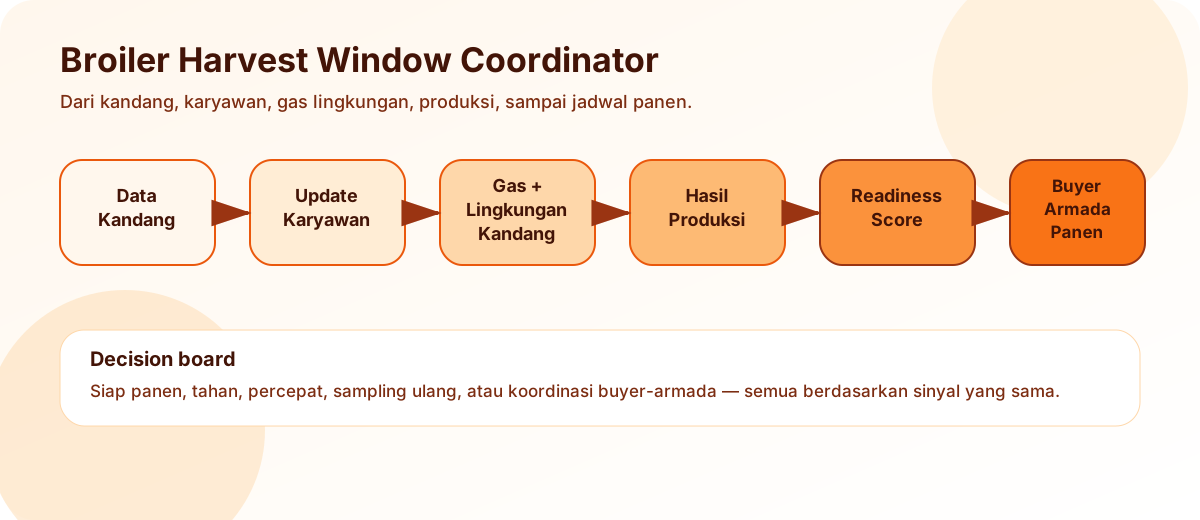
A Broiler Harvest Window Coordinator is a focused workflow product for this exact problem: connecting poultry house data, worker updates, environmental conditions, production performance, transport readiness, buyer demand, and processor schedules into one operational decision board.
Start from the house, because the harvest window begins there
Every broiler house produces daily operational signals. Temperature, humidity, ventilation, litter condition, feed intake, water intake, mortality, sample weight, medication notes, power interruptions, fan issues, and flock density all affect the real readiness of the flock.
If these signals stay inside notebooks or chat groups, management only sees the problem after performance drops. A practical system should turn daily house updates into a simple status: normal, watch, or urgent. The first version does not need to be a complex ERP. It only needs disciplined field input and clear exception visibility.
With that foundation, harvest decisions become more informed. The question is no longer only how old the flock is. The question becomes: is the flock approaching target weight, is FCR still healthy, is mortality stable, is the environment under control, and should this house be harvested, held, or reviewed again before the schedule is locked?
Farm workers are part of the workflow, not just app users
Many farm management systems fail because they design for the owner dashboard first and forget the daily reality of farm workers. A broiler house is physical work. If the form is too long or too complicated, the data will not be updated consistently.
The better starting point is a lightweight daily check-in: mortality count, feed delivery, water issue, sample weight, litter condition, house photos, temperature, humidity, and a short field note. The note can even start as a voice note or chat-style input before it becomes a structured record.
This is not about using software to blame workers. It is about giving the team a clearer routine, helping supervisors see missing updates, and making field problems visible before they become harvest problems.
Fast daily updates from the source.
Mortality, feed, water, sample weight, photos, climate readings, and field notes are captured without heavy admin work.
Review exceptions, not every chat.
Missing updates, rising mortality, gas risk, weight deviation, or poor climate conditions move into a clear review queue.
Decide the harvest window with better context.
Ready, hold, accelerate, resample, or coordinate with buyers and transport using the same operational data.
Methane matters, but ammonia, CO₂, temperature, and humidity matter every day
Methane monitoring is an interesting part of a more advanced poultry house environment layer, especially when manure management, litter conditions, or waste-handling design create the possibility of gas buildup. But in day-to-day broiler operations, ammonia, CO₂, temperature, humidity, dust, and ventilation quality are often the more immediate operational signals.
The important point is not simply installing sensors. The important point is connecting sensor readings to action. If ammonia rises, the system should ask for litter and ventilation checks. If CO₂ is high, airflow needs attention. If temperature and humidity move outside the acceptable range, the system should alert the team before bird stress becomes production loss.
Environmental data becomes powerful when it changes the harvest decision. A house that is close to target weight but showing worsening gas or climate conditions may need to move up the harvest queue. Another house with stable conditions may be safely held for a better buyer or processor slot.
Production performance should tell one continuous story
Broiler production cannot be judged only by the final number of birds harvested. Management needs to see average body weight, uniformity, mortality, feed conversion ratio, age at harvest, performance index, feed intake, estimated versus actual weight, and the reason behind any deviation.
Once daily data is captured consistently, the system can create practical projections. House A may reach target weight on Friday. House B may need resampling because weight gain is slower than expected. House C may be consuming more feed than normal. House D may have rising mortality and should be reviewed before the current harvest plan is confirmed.
Over multiple cycles, this becomes more than a harvest schedule. It becomes an operational learning system. The farm can identify which houses are more stable, which teams update data more reliably, which feed batches correlate with better outcomes, and which environmental patterns often appear before performance drops.
type BroilerHarvestSignal = {
  houseId: string
  ageDays: number
  averageWeightKg: number
  feedConversionRatio: number
  mortalityRate: number
  ammoniaPpm?: number
  co2Ppm?: number
  methanePpm?: number
  temperatureC: number
  humidityPct: number
  harvestReadiness: 'not_ready' | 'watch' | 'ready' | 'urgent'
}
Harvest coordination includes buyers, transport, catching teams, and processors
The harvest problem does not stop at the poultry house. A flock may be ready, but the buyer may not be confirmed. The buyer may be ready, but transport may be late. Transport may be available, but the catching team may be short-handed. The processor may have a limited receiving slot. These moving parts often create the real operational chaos.
A Broiler Harvest Window Coordinator should lock the plan in one place: house, estimated birds, estimated weight, harvest date and time, buyer, destination processor or slaughterhouse, truck assignment, catching team, person in charge, confirmation status, and change history.
The value becomes obvious during busy harvest periods. The owner can see what is planned today, what is at risk tomorrow, and which flock needs buyer coordination before feed cost, body weight, or house conditions move too far from the target.
What NovaFlow would build first
A strong MVP should avoid becoming a full poultry ERP too early. The first version should focus on five practical layers: daily house updates, worker check-ins, environmental monitoring, harvest readiness scoring, and buyer-transport coordination.
Input can begin through a mobile form, a simple web app, or a chat-based workflow. Sensor integration can come in stages: temperature, humidity, ammonia, CO₂, and methane where relevant. The key is the decision flow: house condition becomes risk signal, risk signal becomes harvest recommendation, harvest recommendation becomes buyer and transport coordination, and the final harvest result feeds back into production analytics.
After the MVP is trusted, the product can expand into weight prediction, FCR alerts, worker discipline scoring, scale integration, production cycle reports, and recommendation models based on farm history.
The outcome is controlled harvest, not just better documentation
The goal is not to make farm teams busy filling software. The goal is to make harvest operations more controlled. Daily updates matter because they support decisions. Sensors matter because they trigger action. Worker check-ins matter because they reduce blind spots. Production data matters because it improves the next cycle.
For independent broiler farms, collectors, and poultry processors, this kind of system can create a real operational advantage: earlier risk visibility, cleaner harvest scheduling, stronger buyer coordination, and better understanding of production performance.
That is the opportunity for NovaFlow: not a generic AI app, but a very specific decision system for poultry operations where timing, evidence, environment, and production outcomes are directly connected to margin.