Agentic AI Workflows for Indonesian Business Leaders
How NovaFlow helps Indonesian business leaders apply agentic AI to tender analysis, compliance review, project scoping, and executive execution workflows.
This is an execution problem before it is an AI problem
Most Indonesian SMEs and industrial teams are not short on technical capability. What they are short on is execution bandwidth. Senior engineers, estimators, project leads, and operations managers spend too much time reading tender packages, reconciling compliance evidence, re-drafting scopes, and chasing clarification across scattered documents before work can even begin.
That drag is expensive because it consumes your most capable people with repetitive, document-heavy work. The issue is not that the business lacks software. The issue is that most software still assumes a human will do the reasoning, the comparison, the sequencing, and the follow-through manually.
This is where agentic AI becomes commercially relevant. Not as a novelty chatbot. Not as an interface trick. As an execution layer that can carry a defined objective through multiple steps: read, extract, compare, check, summarize, and return a decision-ready output.
What agentic AI means in an operating environment
In enterprise terms, agentic AI means the system does not stop at one answer. It receives a goal, breaks the work into stages, selects the right tools, preserves state, and hands results from one step to the next until the workflow is complete.
A conventional assistant answers a question. An agentic workflow advances a process. One component parses documents. Another checks the extracted facts against company memory or regulatory logic. Another produces a structured output for review. The value is not “AI that sounds smart.” The value is a workflow that finishes more of the work before a human has to step in.
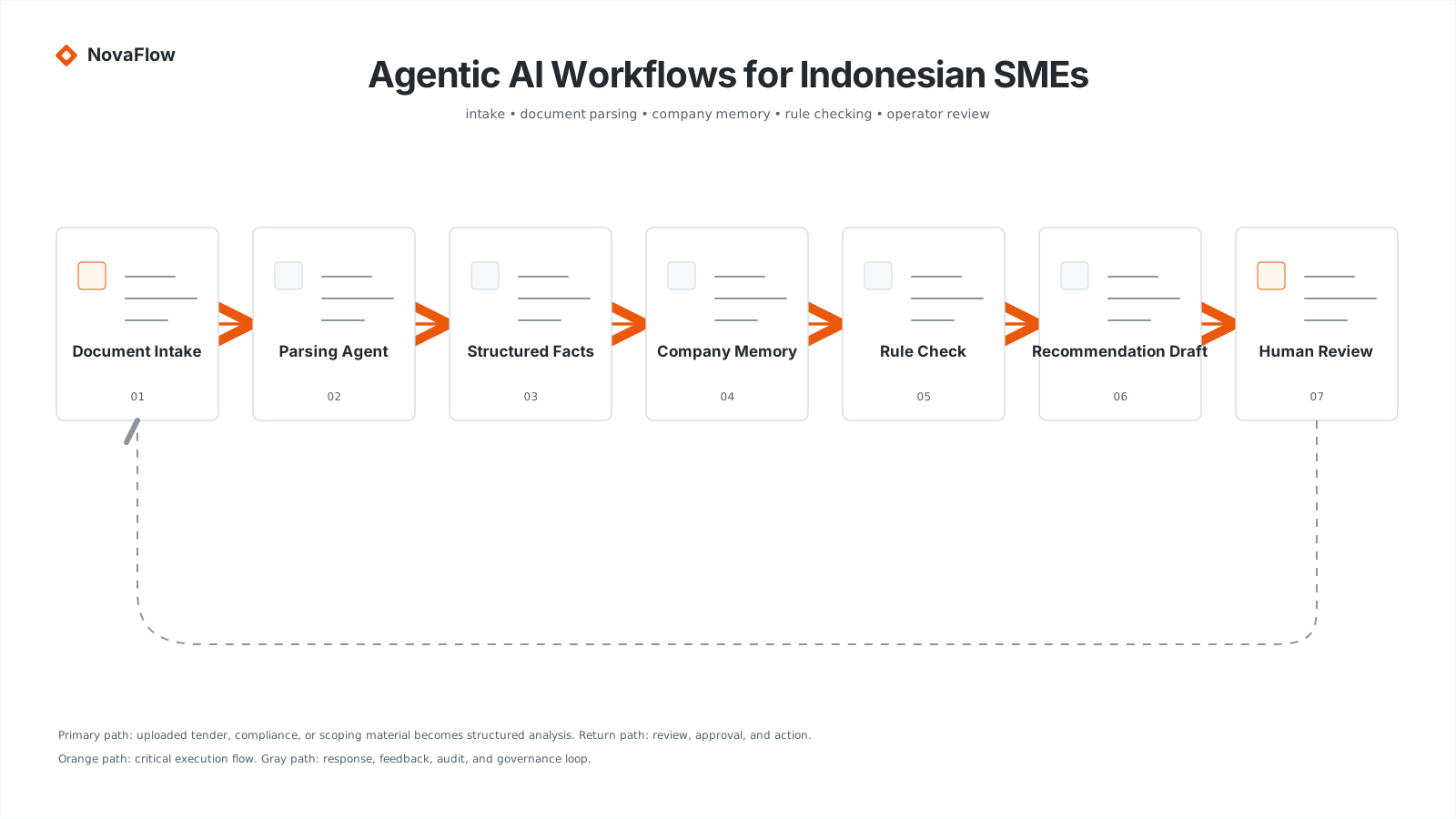
Tender analysis: compress the bid review cycle
Tender review is one of the clearest high-value use cases. A typical tender package may contain technical specifications, qualification clauses, commercial terms, evaluation criteria, and administrative requirements across hundreds of pages. Most teams still review this manually, then compare it against internal capabilities, certifications, equipment, and delivery constraints.
An agentic tender workflow shortens that cycle materially. It parses the document set, extracts deadlines and hard requirements, compares them against the company profile, and produces a structured gap analysis showing what is covered, what is missing, and what requires action. That action may involve an additional document, management confirmation, or a subcontracting decision.
The gain is not just speed. It is review quality under pressure. The workflow is less likely to miss an exclusion clause, a mandatory certificate, or an evaluation condition because somebody was working through the stack at midnight.
type TenderAssessment = {
  tenderId: string
  deadlines: string[]
  requiredCertifications: string[]
  technicalRequirements: string[]
  evaluationFactors: string[]
  capabilityMatches: string[]
  capabilityGaps: string[]
  recommendation: 'bid' | 'bid_with_conditions' | 'no_bid'
}
Compliance review: move from checklist admin to operational readiness
Industrial compliance in Indonesia is rarely a single-rule environment. Teams deal with K3 obligations, environmental permits, client HSE standards, equipment certification, location-specific administration, and audit evidence that lives across multiple files and revisions.
A strong agentic compliance workflow does more than list requirements. It reads the relevant operational documents, determines which rules apply to the project, flags missing or weak evidence, and cites the relevant clause so the team can act with precision. That matters because compliance failures rarely come from total ignorance. They usually come from fragmented records, inconsistent naming, and last-minute evidence hunts.
Once the workflow is connected to company memory, it can cross-check project type, site location, permit status, training records, inspection history, and current requirements as one review surface instead of forcing staff to rebuild that context manually every time.
Project scoping: protect margin before execution starts
Many projects lose margin long before the first field activity. The client brief is incomplete, the internal estimate is rushed, assumptions are buried in someone’s head, and the scope keeps changing because the first draft was assembled too loosely.
An agentic scoping workflow provides a stronger starting point. It can ingest the RFQ or LOI, compare it to similar historical work, draft a structured scope, propose preliminary resource needs, and surface risk areas where ambiguity is likely to become commercial leakage.
That does not replace the project manager. It increases the quality of the first draft so the project manager can spend time on judgment, commercial positioning, and capacity planning instead of rebuilding the scope from scratch.
async function draftProjectScope(rfq, companyMemory) {
  const extracted = await parseRequirements(rfq)
  const comparables = await loadSimilarProjects(companyMemory, extracted.category)
  return buildDraftScope({
    requirements: extracted,
    comparables,
    includeRiskRegister: true,
    includeResourcePlan: true,
    includeMilestones: true
  })
}
The architecture must be governed, not fragile
The practical architecture is straightforward. Agents are specialized workers. Tools are the capabilities they can use. Workflows define the order, conditions, and outputs. Memory stores company-specific facts outside the model so results remain grounded in the organization’s real operating context.
This matters because many AI experiments fail by sending everything into a single oversized prompt and hoping for a usable answer. That pattern is expensive, hard to audit, and difficult to trust. A workflow-driven design is more stable because parsing, rule checking, comparison, synthesis, and approval are separated into explicit stages.
const workflow = {
  intake: 'document_upload_or_trigger',
  steps: ['document_parse', 'fact_extract', 'memory_lookup', 'rule_check', 'report_synthesis'],
  output: 'structured_recommendation',
  review: 'human_approval_required'
}
The economics are clearer than most teams expect
For SMEs, the commercial case is usually stronger than the technical case. A senior engineer or project lead may spend a substantial portion of each month on tender review, requirement checking, compliance preparation, and scope drafting. That cost already exists, even if it is buried inside normal payroll.
If the workflow reduces two or three days of senior review work into an hour of structured machine processing plus human review, the return appears quickly. More importantly, the business reduces costly inconsistency: missed requirements, weak compliance evidence, and under-scoped work are usually more expensive than the API bill that prevented them.
That is the right ROI lens. Not “how cheap is the model call?” but “how much expensive human capacity is currently being burned on repetitive document work, and what business risk is attached to that manual process?”
Why this matters now
The timing is not theoretical. Model quality has improved enough to handle mixed Indonesian and English business documentation with far better reliability than even a year ago. At the same time, larger contractors and industrial groups are already institutionalizing internal AI capability around document-heavy workflows.
That creates a practical competitive gap. If one team can review tenders faster, check compliance more consistently, and scope work with less margin leakage, that team is operating with a structural advantage. The businesses that move first will not necessarily have the most sophisticated AI. They will have the best workflow discipline around it.
Start with one workflow that already hurts
The right entry point is not an “AI transformation” program. It is one workflow where delay, repetition, document volume, and failure cost are already obvious. For many industrial teams, that starts with tender analysis. For others, it may be compliance review, permit tracking, scope drafting, or structured reporting.
That is the model we use at NovaFlow. Start with the bottleneck. Map the current process. Define the decision points, inputs, tools, and approval boundaries. Then build an agentic workflow that removes administrative drag without removing human control. That is how AI becomes operational infrastructure instead of presentation layer theater.